Sunday, April 26, 2015

A Cloth of Power- The Shroud of Turin

The Shroud of Turin

I have often given a lecture entitled ”Magic Clothes of Power”.  There are many instances of textiles that are reported to have special powers.  These fabrics are not merely symbols of power, such as military uniforms or religious vestments, but have intrinsic powers, which are derived from special fibers, or are granted properties from “other-worldly” sources.  Folklore and literature are sources of many tales of “clothes of power” such as special cloaks, flying carpets and ruby red shoes.  Many people have traditions that  include reverence for textiles which, they believe, can provide protection or bring good fortune.

Last Sunday the Shroud of Turin went on exhibition in Turin, Italy, which will run until June, 24th. As early as the 6th C there have appreared certain images of Jesus said to be “not made with hands”.  The earliest legend concerns the “Image of Edessa”.  The king of Edessa (Turkey) wrote to Jesus asking him to come and cure him of leprosy.   Unable to visit, Jesus sent a miraculous self-portrait imbued with curative power.  Some equate the Shroud of Turin with the Edessa story, however the Shroud bears the entire front and back impressions of an apparently crucified man.


There has long been controversy on whether this textile is the burial shroud of Jesus Christ or a medieval fabrication.  Results of carbon-dating posited the age of this textile to be no older than the 1200’s.  Others suggest that the actual date cannot be determined due to contamination by centuries of manipulation.    The 14 ½ foot of linen fiber is owned by the pope but it is in the care of the archdiocese of Turin.   The Catholic Church does not make any claims toward its authenticity and has long acknowledged that there are disagreements and questions that have not been successfully addressed.

Despite the controversy, there have been more than a million free tickets reserved by would-be visitors, and many dates for viewing have already sold out.

There are other “Miraculous” portraits of Jesus, including the Veronica Veils.  Veronica was  a wealthy woman of Jerusalem who witnessed the journey to Golgatha that Christ made with the cross.  She wiped his face with her veil and his visage was imprinted upon it.  There were many ”originals” of the textile and it was assumed that they had been painted.  The legend asserts that the image could duplicate itself miraculously


Sunday, April 19, 2015

International Fashion

The Runway

Every year “fashion week” appears on the runways of Paris, New York and London as well as other international venues.  Designers present their collections modeled by professionals looking like bored mannequins. These collections are the artistic expressions of what is considered to be the most promising talents and also seasoned textile designers. While some of the fabric creations appear somewhat “over-the-top” they are intended to present the vision of what textile fashion could become.  Amazing manipulations of fabrics, dazzling embellishments and rainbows of color combinations can be seen on the “cat walks”.

It may be compared to the reactions from the art salons when paintings from the Impressionists, Surrealists, Minimalists and other forward thinking artists pushed the envelope.  Now we view these as masterpieces which reveal windows into the public psyche.    Innovation is sometimes disturbing as it removes us from our comfort zones.

But take heart.  Couture and ready-to-wear are two different animals, and the history of their rivalry is an interesting study in manufacture, marketing and creative ambitions.


This new addition to my reference library is not “just a history of fashion from the early days of the creation of dressmaking fashion to the development of ready-to-wear manufacturing…Its ambition is to be the story of the creation, the evolution and the implosion of the fashion-related professions.” Dider Grumbach


 History of International Fashion, Didier Grumbach, Interlink Boks, Northampton, MA, 2014


There are so many factors involved in the history of fashion and design, many of which, are not widely known nor considered.  This volume explores these factors in their historical perspective and introduces us to the many people who influenced its development.

Sunday, April 5, 2015

At Last- The New Textile Museum, Washington, D.C.

The Textile Museum

The Textile Museum, Washington, D.C. has finally opened  its new facility.  In 2012 there was ground-breaking for the new facility located on the Foggy Bottom campus of George Washington University. 

Formerly located at 2320 S Street, the museum was housed in the original house of its founder, George Hewitt Myers. Hewitt-Meyers was a textile expert and collector.  While the Georgian style house was lovely, there was a serious problem with sufficient storage, conservation and research, not to mention the terrible parking situation.

The long-awaited, new museum, 53,000 sq ft, opened March 21, 2015. 


The textile collection is partnered with the collection of the University, on historic Washington.  It is located at Foggy Bottom, 21st and J street NW.  An additional building for conservation and research has been constructed on the GWU campus in Loudon County, Va.

You can get information on the new museum and its scheduled calendar of events and exhibitions at museum.gwu.edu.
The museum hours are:
 Mon., Wed.-Fri. 11:30am-6:30pm; Saturday 10am-5pm; Sunday 1pm-5pm.

  The museum is closed Tuesdays and holidays.

Sunday, March 29, 2015

A Spring Holiday


A Spring Holiday

Easter usually signals the beginning of spring for many of us.  Flowers begin to bloom and the grass becomes greener.  Baby animals and birds appear, and heavy, winter clothes are replaced with pastel, lightweight attire.  When I was small, Easter also meant flowery hats and a corsage for my mother.

I reviewed my blogs of the past 3 years for textile images to share again and to celebrate spring.


Bunnies and lambs

            3 early 20th C embroideries, 1930's


Embroidery on a pre-patterned feedsack.  Note the ink from the sack of navy beans was indelible.


Easter baskets

Petite crochet baskets


Candies for your Easter basket

These are the incredible ribbon creations of textile artist 
Candace Kling 
Threads Magazine, Tauton Press, 1991


These are my humble creations.


Spring is a renewal, so plant your gardens, take good care of our earth and enjoy the bounties of nature wherever you are.

Sunday, March 22, 2015

Feather Embellishments

. Feathered Friends


This morning I was awakened by the chirping of birds outside the bedroom window, a sure sign of spring.  Birds are migrating north and house finches are building nests throughout the neighborhood.  We even have a pair of doves that roost in the grape vines that cover our patio roof lattice.


Early humans embellished their textiles as aesthetic expressions of their individuality or clan identity.  Feathers, beads and shells were popular materials used for this purpose.  Feathers, while plentiful were also more delicate than stones and shells and required some expertise to firmly attach them to textiles.

Many examples of early feather embellishment are well known.  Polynesians wore feathered cloaks and skirts. 


So popular were these garments that many birds were led to extinction, such as the  New Zealand Moa.


Moas were very large, flightless birds that made them easy prey.


Native Americans wore feathered cloaks and headdresses.

Exotic birds produced splendid feathers that were incorporated into fashionable accessories for women with expensive tastes and more modest products were manufactured for the average consumer using more common feathers.


Passenger Pigeon feathers were in great demand in the 19th C as adornments, especially for womens hats.  While they were, at one time, the most populous bird in, perhaps, all the world they,too, fell into extinction.


Needlecraft Magazine, October, 1928


The American Needle Woman, January, 1926


Ostritch  feathers, because of there strength and size were popular materials for fans.


Advertisement from Sears and Roebuck & Co. catalog, Fall, 1900 featuring assorted feathers and whole parrots, available in either black or green, also colored pigeons.  The price, a whopping 59 cents.


Vintage, lady's evening purse with quail feather adornment.


The Vogue Sewing Book, 1975, pg 392 describes the technique of attaching purchased strips of feathers.  They advocated "Don't be skimpy-use rows and rows of them for a lavish effect".


Today, couturier creations feature opulent garments adorned with masses of beads, sequins, pearls, lace and feathers.  While these are pieces of modern textile art they are not practical for the average wearer and feathered embellishments are now used as decorative elements on accessories.

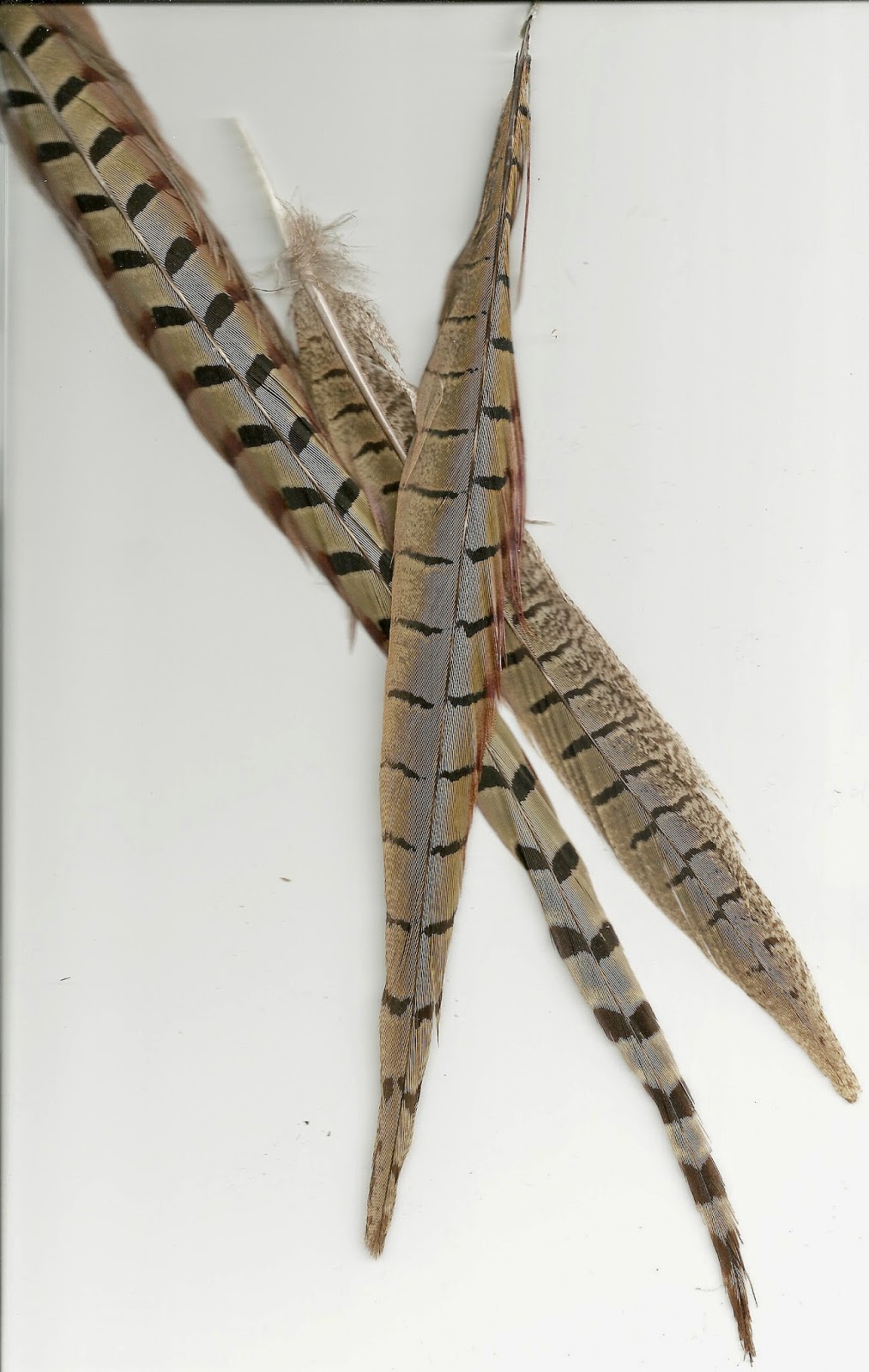
Feathers can be purchased from craft shops as well as on-line.  Or you can gather them from under your bird feeders.


 Purchased turkey feathers


            Purchased pheasant feathers


Under-my-bird-feeder feathers


Sunday, March 15, 2015

Tartans

Tartan,  Plaid By Any Other Name

Plaid now refers to a pattern of stripes and checks, but originally, it was a type of Scottish Highland dress.  Scottish kilts, 2 yards wide by 6 yards long, are worn pleated around the wearer.  Plaid also refers to a shawl or mantle worn over the shoulder and fastened with a brooch.  Now we call this type of pattern, Tartan.  Originally, Highlanders called tartan “Breacan” from Gaelic meaning “spotted”.  Some claim the word “tartan is related to the Old French word “Tiritaine”, meaning rough and wooly.  Others say it comes from Gaelic “Taratin” meaning across, which seems more likely.


Tartans, Belvedere Designbook: FashionTextiles, Graphic Designs, Wolfgang Hageney, ed., Belvedere Ltd, Milan, 1987  


The use of tartan is associated with clan culture.  The pattern and color of the cloth is prescribed by the clan.  The clan could have several tartans, most have 4.  The Chief tartan is reserved for the chief and close relatives, Clan tartans for the other clan members.  The “Hunting” tartan was usually earth colored for everyday use and Dress tartan for formal occasions


                    Ferguson


                    Macpherson, Dress


Tartan is a plain, 2/2 twill weave.  The stripes of colored yarn are in both the warp and the weft.  A tartan can be made is any size, depending upon its use, but the proportions of the widths of the stripes (sett) must always remain the same.  

While many ethnic groups have replaced their native dress with western wear it is interesting to see  Scottish clan dress worn , not only for special festivities but often for everyday.  On our many trips to the Highlands we have even seen a lone kilt-wearing Scotsman playing the bagpipe in the median strip of a highway coming from Inverness.

Sunday, March 8, 2015

Building Your Textile Library

Starting a Textile Library

I have a weakness for books.  Our home has floor-to-ceiling bookcases filled with books.  My office has bookcases filled with textile reference books.  I received a question not long ago asking if , in this day of internet information, it  is necessary to acquire texts for a personal library.  My answer is emphatically, “yes”.

Firstly, you must decide what type of library would be of the most use to you, would bring you the most information and the most enjoyment.  If there is a specific type of  textile, a specific time period, or region of the world that is of primary interest to you, then  you have a great starting point.  Today, there are so many publications on the market that cover every aspect of textile design, production, and collection.  These range from beautifully illustrated coffee table type books with stunning photographs to scholarly presentations. 

Once you have your starting point do you self a favor and spend time visiting libraries and book stores where you can actually examine the material.  What may sound interesting in a written review may not suit your level of interest.  What I look for are lots of illustrations, preferably in color, a bibliography and index, and a glossary of terms.

Since my field is general textile history from prehistoric textiles to contemporary designs and production methods, nearly any book would fit into my library catalog.  But since I am in the textile minority, having no specialization, you will wish to limit your purchases, but I must warn you, once you begin it may be hard to stop.  Another good resource is the library at your local museum (not necessarily just their bookstore) as curators and staff may have good recommendations for you..

Sources are obvious: bookstores and the internet.  The internet will provide sales information on all ranges , and prices from current editions to those which may be out of print.  Do not overlook second-hand bookstores or thrift shops, flea markets and garage sales.  Often older books contain a wealth of information, although some information, not well researched may be misleading.  Nevertheless they are often a delight to read.

To answer my reader’s question, there is no substitute for seeing actual textiles.  Museum collections, galleries and such are good.  The best would be access to actual textiles for you to examine.  One way is to become a member of a museum’s textile  group, join a textile related guild,  become a docent or take a course at  your local college.  While the internet may offer information, many sources are redundant, but they can provide you with a starting point for further research.  Books, however, are there when you wish to investigate a topic or spend time analyzing textile properties, such as design (which is why it is important to have a volume that has as many good quality photographs and illustrations as possible).  While I have my tried-and-true reference volumes which are constantly used, I often will select a book from the back  shelf which I haven’t really examined in some time.  I never have spent any length of time browsing through these editions without learning something I have not considered.


So, fellow enthusiasts, there is unlimited resources available and as your reference collection grows, I am sure your textile collection will do so also.