Sunday, November 19, 2017
Thursday, November 9, 2017
Celebrating Italian Design
A Tribute to Italian Design
While we were in Milan ( see my blog on Milan fashion week) wandering and window
shopping I spied the most awesome store front in the plaza across from the
famous La Scala Opera House. The first
floor of a block-long building showed the interior of a high-end haberdashery
shop. Through the windows the public
could see stacks of fabrics, masses of buttons, zippers and all manner of
sewing accessories. This display was so
realistic that many people tried to enter the building. I admit, I would have spent days and days
within. But, of course, none of this
wonderment was real. It was the most
clever façade celebrating Italian design.
There were other public displays to be found around the city featuring
design in many areas.
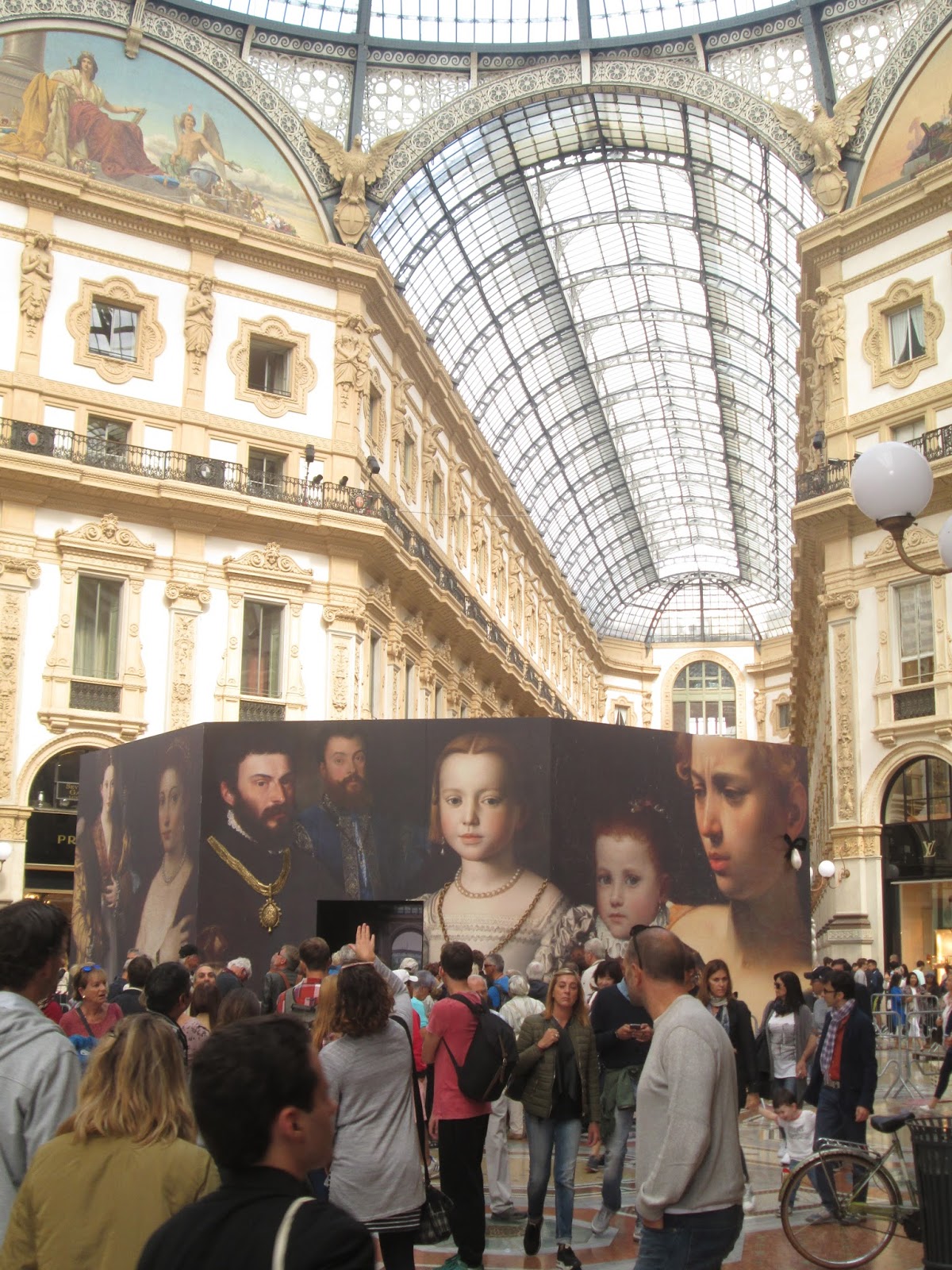
This is another Italian Design display found in the Galleria
Vittorio Emanuele II. This ornate
shopping arcade has a floor plan on the shape of a Latin cross. Mosaics represent the continents of Asia,
Europe, America and Africa and the glass and metal ceiling was the first in Italy to be structural rather than merely decorative. This display, in front of the Prada flagship
store, featured Italy’s great reputation as jewelers to the world. Renaissance figures adorned billboard-sized
panels, dressed in finery, and, of course, their fabulous jewels. The jewels were showcased in three dimensions
.
You just never know what you might encounter.
Wednesday, October 18, 2017
Italian Fashion Week- Milan
Milan Fashion Week
We recently returned from a short trip to Italy, beginning
with Milan during Fashion Week. Milan,
capital of the Lombardy region in northern Italy which stretches from the Alps
bordering Switzerland to the flat plain of the river Po, is both the financial
and fashion capital of Italy. A fashion
design rival of both New York and Paris, Milan hosted more than 60 fashion
shows and more than 80 presentations with
800 showrooms throughout the city.
“This is an Italian city of progress and change” stated “King” Giorgio
Armani.
Before a glimpse at the fashions for spring, 2028, let’s
take a walk through the so-called “fashion quadrilateral” ( Via Montenapoleone,
Via della Spiga, Via Manzoni. And Via sant’Andrea). Flagship stores from Armani
to Versache along with many independent
boutiques offer a window-shoppers dream.
The one word I thought of as I viewed the fall and winter displays was
“texture”. Designs were often of
several fabrics, heavily textured (some bulky). The addition of animal furs ( and hair) both faux and real added additional layers which, at times
appeared to be in their natural state.
Long rovings of slightly curly fleece-like material hung from the waist
or hem of garments. (I called this the
“wet English sheep-dog look”) Other
trimmings were fine textured, obviously synthetic and highly colored, Even
handbags could not escape this furry look.
Prada
Prada
But you did not have to spend your Euros in the up-scale
establishments, as the market stalls offered much cheaper versions.
The promise of Spring was similar but slightly more
refined. Plaids and checks from head to
toe and multicolored jackets worn with cowboy boots. But there was also shimmer and glitz with Armani’s shiny black
suits and iridescent fabrics from Gucci.
But fear not, fringe was still shown , now floating on the hemline of
long dresses.
Though those of us who do not walk the red carpets , do not
greet heads of state, nor jet around the world with valets to care for their
wardrobes can still appreciate these outpourings of fashion creativity. The “trickle-down effect” soon reaches the
ready-to-wear consumers and don’t we all want to be in fashion?
Wednesday, September 13, 2017
A Spider Silk Sweater
Spider Silk
On the outside of the patio door to my office is a huge
spider web. I would say about 18 inches
in diameter and tethered to various
hanging baskets. The spider responsible
is an enormous orange garden spider who appears occasionally in the center of
the web, otherwise I don’t know where it resides, which, I admit makes me
nervous when I’m outside. I don’t like
spiders at all, but “Goldie” is living outside and her web is so delicate and
intricate that I find myself looking at it often.
fabric swatch American, cotton, c 1930
\
Many years ago I was writing an introductory course on
Textile History (Textiles 101, if you
will) and prepared a lecture on little-known animal fibers. Several animals produce silk filaments, of
course Bombyx mori is the most notable, but certain mollusks, insects, as well
as my “unfriends” the arachnids.
According to the Roman poet, Ovid, Arachne was widely noted
for her weaving skills and challenged the goddess Athena to a contest, which,
apparently she won hands-down. Now
Athena was never known to be a gracious loser and in a rage of envy destroyed
Arachne’s beautiful tapestry. In
despair, Arachne tried to hang herself , but was transformed by Athena into a
spider.
As silk producers, arachnids ( nearly 300 million years ago)
far preceded the silk “worm”.
The physical properties are very impressive. Different species produce silk of varying
characteristics. Spider attachment
discs are made of a strong glue to secure the draglines and framelines. Certain species produce a dragline silk that
is stronger by weight to steel, surpassing Kevlar. This excellent tensile strength has been suggested that a pencil
thick strand of silk could stop a 747 in flight., and its elasticity is
superior to Nylon. Some silks are good
insulators, while some absorb water, and some are water resistant. The reason insects, when in contact with a
web, cannot escape their demise is as special silken thread called “cribellate” which forms a fine sticky mat combed atop the more substantial silk tract.
Historically, several cultures have used spider silk
medicinally , as well as for fishing nets
There have been attempts to use the silk for textiles in the early
1700’s but the care of the living spiders proved too difficult. Speaking of difficult, in the 1800’s spider
silk was reeled directly from harnessed spiders. The military has long investigated spider silk for strong
lightweight materials.
DuPont’s advertisement in the Scientific American of July
1996 tells that they were studying these biopolymer structures of spider webs
by using recombinant DNA technology. I
had not heard more about this research until several years ago while attending
a Textile Society conference, I met a retired chemist who had worked for
DuPont. She told me a fellow chemist
had resurrected these studies. So
maybe, we shall see spider filament for use in textiles.
For me, a spider silk
sweater, NO WAY!!!!
Sunday, August 27, 2017
Researching the Textiles of Ancient Peru
Referencing Pre-Columbian Peruvian Textiles
After visiting the Amaco museum of pre-Columbian Peruvian textiles in January (See my blog Textile Treasure of Ancient Peru, 2/19/17) I was inspired to do more research on the cultures of ancient Peru. Here are only a few of references I am using.
DK Publishing INC, NY
Paul Hughes, FINE TEXTILE ART, London, 1995
Andreas Lommel, Hamilton publishing Group LTD, 1966
Samuel K. Lothrop, Rizoli INC., 1964
Lucy Davies & Mo Fini, Chronicle Books, San Francisco, 1994
There is also much information available on the internet. The images of textiles created thousands of years ago by these peoples is truly inspiring.
A few ancient textile tidbits, for now
After visiting the Amaco museum of pre-Columbian Peruvian textiles in January (See my blog Textile Treasure of Ancient Peru, 2/19/17) I was inspired to do more research on the cultures of ancient Peru. Here are only a few of references I am using.
DK Publishing INC, NY
Paul Hughes, FINE TEXTILE ART, London, 1995
Andreas Lommel, Hamilton publishing Group LTD, 1966
Samuel K. Lothrop, Rizoli INC., 1964
Lucy Davies & Mo Fini, Chronicle Books, San Francisco, 1994
There is also much information available on the internet. The images of textiles created thousands of years ago by these peoples is truly inspiring.
A few ancient textile tidbits, for now
Feathered textile, Amanco Museum
Weaving fragment, Amano Museum
Friday, August 4, 2017
Magic Clothes of Power:- Episode 1, The Wild Swans
Magic Cloths of
Power
For many years I have been asked to present lectures on
various textile topics. One of my very
favorite topics I will share with you over several months : Magic Clothes of Power.
I once had read a book by Barbara Michaels about a “bad”
quilt. It was not poorly constructed,
not green and purple and orange, it was EVIL. and very dire consequences befell
anyone who came to be associated with this textile. So I began gathering stories and information about textiles that
had intrinsic powers. Not represented
power, such as flags or military uniforms, but possessed actual , beyond the
norm, abilities.
Folklore and literature abound with these legends. However there are equally as many accounts
of peoples and cultures that, today, believe that certain textiles have been
empowered in some way either by their creator, or the fibers and materials used
in their manufacture, or by some divine intervention.
Today, I go to literature for such an account: “Wild Swans”,
Denmark, Hans Christian Anderson.
In this story, a beautiful princess weaves shirts made from
the fibers of the stinging nettle plant for her 11 brothers. It seems that their evil stepmother had cast
a spell upon the boys, turning them into wild swans. A good witch told the princess the completed shirts, when worn by
her brothers, would turn them from swans back into young men again. These wonderfully soft shirts made of
something so unlikely could reverse magical spells and would endow their
wearers with magical powers. And so it was.
There is, usually, in the background of such stories a grain of truth. In this case, it is the fiber of the nettle
plant. Stinging nettle – Urtica dioica,
is a herbaceous perennial 1-2 meters in height, found abundantly in boggy areas
in northern Europe and Asia, less commonly found in Canada and US. The underside of the leaves are found with
slender hairs containing several toxic chemicals which are released when
brushed against causing itching and pain.
The textile fiber is a bast fiber found in the stem and is
processed like flax.into very soft , supple fabric. Nettle, which was still
used in northern, central and eastern Europe well into the 20th C,
was found in a tomb in Denmark dating to 1,000 BCE. White fibers originally believed to be flax by archeologists were
later shown to be nettle. When Germany
and Austria ran short of cotton during the war, the value of nettle was recognized
and 2 species were chosen for textiles.
It is estimated that Germany harvested over two thousand tons of wild
nettles to weave fabric for their shoulders.
Several years age, my husband and I were dining in a restaurant
in Istanbul which served us steamed nettle, apparently the toxins are
eliminated by cooking. Frankly , it
tasted much like any cooked green.
I will share more of these textile tales in upcoming blogs.
Sunday, July 16, 2017
"E" is for Eyelet
Eyelet
Eyelet fabric can be described as a combination of lace and
embroidery. It can be found in a
variety of patterns which cover the fabric surface from selvage to
selvage. Usually produced in white but
occasionally it can be found in colors.
The design is punched into the fabric ground by a series of
knives called bohers. The “hole is then
stitched to prevent fraying.
In the 1860’s an early hand-operated embroidery machine was
developed, subsequently, a 24 needle machine was produce which could be powered
by hand or electricity.. This machine
was known as the “schiffli”, German for boat.
Programs were written in punch paper( somewhat similar to Jacqard
weaving and computer punch cards).
Early schiffli machine circa 1910. Note the machine operator is following the punch pattern.
Today a modern schiffli machine is 65 feet long and 16 feet
high, containing 1,020 needles.. Most manufacturers in the US using these
embroidery machines are in New Jersey. These
machines are computer run.
Subscribe to:
Posts (Atom)