Sunday, March 22, 2015

Feather Embellishments

. Feathered Friends


This morning I was awakened by the chirping of birds outside the bedroom window, a sure sign of spring.  Birds are migrating north and house finches are building nests throughout the neighborhood.  We even have a pair of doves that roost in the grape vines that cover our patio roof lattice.


Early humans embellished their textiles as aesthetic expressions of their individuality or clan identity.  Feathers, beads and shells were popular materials used for this purpose.  Feathers, while plentiful were also more delicate than stones and shells and required some expertise to firmly attach them to textiles.

Many examples of early feather embellishment are well known.  Polynesians wore feathered cloaks and skirts. 


So popular were these garments that many birds were led to extinction, such as the  New Zealand Moa.


Moas were very large, flightless birds that made them easy prey.


Native Americans wore feathered cloaks and headdresses.

Exotic birds produced splendid feathers that were incorporated into fashionable accessories for women with expensive tastes and more modest products were manufactured for the average consumer using more common feathers.


Passenger Pigeon feathers were in great demand in the 19th C as adornments, especially for womens hats.  While they were, at one time, the most populous bird in, perhaps, all the world they,too, fell into extinction.


Needlecraft Magazine, October, 1928


The American Needle Woman, January, 1926


Ostritch  feathers, because of there strength and size were popular materials for fans.


Advertisement from Sears and Roebuck & Co. catalog, Fall, 1900 featuring assorted feathers and whole parrots, available in either black or green, also colored pigeons.  The price, a whopping 59 cents.


Vintage, lady's evening purse with quail feather adornment.


The Vogue Sewing Book, 1975, pg 392 describes the technique of attaching purchased strips of feathers.  They advocated "Don't be skimpy-use rows and rows of them for a lavish effect".


Today, couturier creations feature opulent garments adorned with masses of beads, sequins, pearls, lace and feathers.  While these are pieces of modern textile art they are not practical for the average wearer and feathered embellishments are now used as decorative elements on accessories.

Feathers can be purchased from craft shops as well as on-line.  Or you can gather them from under your bird feeders.


 Purchased turkey feathers


            Purchased pheasant feathers
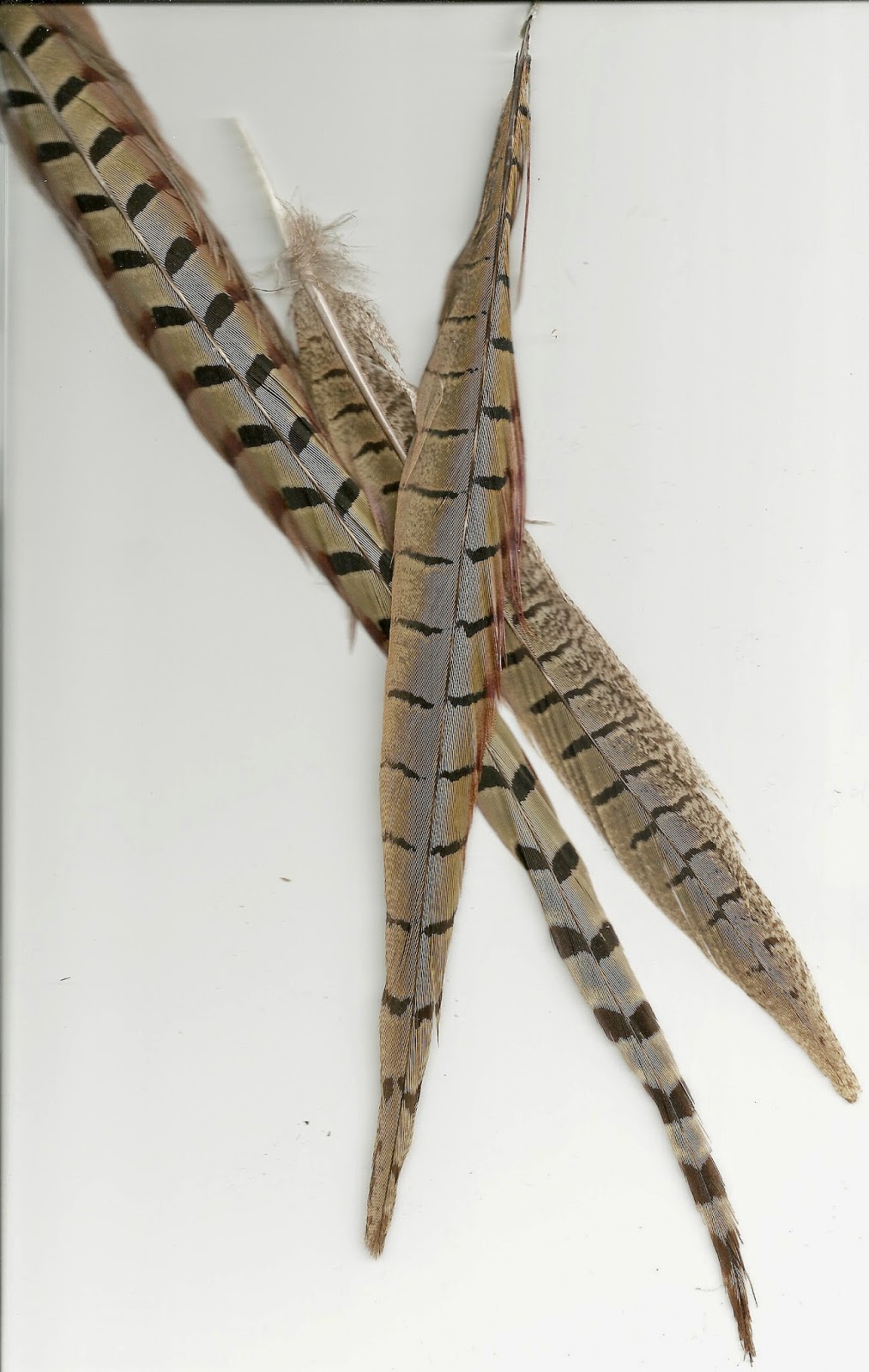


Under-my-bird-feeder feathers


Sunday, March 15, 2015

Tartans

Tartan,  Plaid By Any Other Name

Plaid now refers to a pattern of stripes and checks, but originally, it was a type of Scottish Highland dress.  Scottish kilts, 2 yards wide by 6 yards long, are worn pleated around the wearer.  Plaid also refers to a shawl or mantle worn over the shoulder and fastened with a brooch.  Now we call this type of pattern, Tartan.  Originally, Highlanders called tartan “Breacan” from Gaelic meaning “spotted”.  Some claim the word “tartan is related to the Old French word “Tiritaine”, meaning rough and wooly.  Others say it comes from Gaelic “Taratin” meaning across, which seems more likely.


Tartans, Belvedere Designbook: FashionTextiles, Graphic Designs, Wolfgang Hageney, ed., Belvedere Ltd, Milan, 1987  


The use of tartan is associated with clan culture.  The pattern and color of the cloth is prescribed by the clan.  The clan could have several tartans, most have 4.  The Chief tartan is reserved for the chief and close relatives, Clan tartans for the other clan members.  The “Hunting” tartan was usually earth colored for everyday use and Dress tartan for formal occasions


                    Ferguson


                    Macpherson, Dress


Tartan is a plain, 2/2 twill weave.  The stripes of colored yarn are in both the warp and the weft.  A tartan can be made is any size, depending upon its use, but the proportions of the widths of the stripes (sett) must always remain the same.  

While many ethnic groups have replaced their native dress with western wear it is interesting to see  Scottish clan dress worn , not only for special festivities but often for everyday.  On our many trips to the Highlands we have even seen a lone kilt-wearing Scotsman playing the bagpipe in the median strip of a highway coming from Inverness.

Sunday, March 8, 2015

Building Your Textile Library

Starting a Textile Library

I have a weakness for books.  Our home has floor-to-ceiling bookcases filled with books.  My office has bookcases filled with textile reference books.  I received a question not long ago asking if , in this day of internet information, it  is necessary to acquire texts for a personal library.  My answer is emphatically, “yes”.

Firstly, you must decide what type of library would be of the most use to you, would bring you the most information and the most enjoyment.  If there is a specific type of  textile, a specific time period, or region of the world that is of primary interest to you, then  you have a great starting point.  Today, there are so many publications on the market that cover every aspect of textile design, production, and collection.  These range from beautifully illustrated coffee table type books with stunning photographs to scholarly presentations. 

Once you have your starting point do you self a favor and spend time visiting libraries and book stores where you can actually examine the material.  What may sound interesting in a written review may not suit your level of interest.  What I look for are lots of illustrations, preferably in color, a bibliography and index, and a glossary of terms.

Since my field is general textile history from prehistoric textiles to contemporary designs and production methods, nearly any book would fit into my library catalog.  But since I am in the textile minority, having no specialization, you will wish to limit your purchases, but I must warn you, once you begin it may be hard to stop.  Another good resource is the library at your local museum (not necessarily just their bookstore) as curators and staff may have good recommendations for you..

Sources are obvious: bookstores and the internet.  The internet will provide sales information on all ranges , and prices from current editions to those which may be out of print.  Do not overlook second-hand bookstores or thrift shops, flea markets and garage sales.  Often older books contain a wealth of information, although some information, not well researched may be misleading.  Nevertheless they are often a delight to read.

To answer my reader’s question, there is no substitute for seeing actual textiles.  Museum collections, galleries and such are good.  The best would be access to actual textiles for you to examine.  One way is to become a member of a museum’s textile  group, join a textile related guild,  become a docent or take a course at  your local college.  While the internet may offer information, many sources are redundant, but they can provide you with a starting point for further research.  Books, however, are there when you wish to investigate a topic or spend time analyzing textile properties, such as design (which is why it is important to have a volume that has as many good quality photographs and illustrations as possible).  While I have my tried-and-true reference volumes which are constantly used, I often will select a book from the back  shelf which I haven’t really examined in some time.  I never have spent any length of time browsing through these editions without learning something I have not considered.


So, fellow enthusiasts, there is unlimited resources available and as your reference collection grows, I am sure your textile collection will do so also.

Sunday, March 1, 2015

Blackwork and Redwork

Blackwork/Redwork Embroidery

There is some confusion over these two embroidery styles.  It is not just the obvious difference of the colored thread.

Let us start with Blackwork.  Traditionally blackwork was black silk thread used to embroider mosaic designs onto white linen.  Some early writers attributed the introduction of this embroidery to Catherine of Aragon and was called “Spanish work”. It reached the height of popularity in England in the 16thC and early 17thC.  Actually, it was known in England before Catherine arrived in 1501. However, they were correct associating it with Spain and the Moorish invasions from northern Africa.  Historically, the Moors settled in  the south of Spain in 711 CE and introduced their geometric motifs simply outlined in black on a white ground.  These Arabesque designs were adapted by the Spanish , and later other European countries. 
The stitches employed were back stitch, braid stitch, buttonhole, coral, double-running seeding or speckling stitches.  Often it was highlighted with silver metallic thread.  When first introduced Spanish work was used in edge treatments for collars an cuffs, and delicate in quality.  As fashions changed, the work became more elaborate and embellished larger areas of dress.  The motifs also changed from the geometric to flowing floral and imaginary bestial designs.  Even simple designs became more intense by using filling stitches.


Blackwork Embroidery, Elizabeth Geddes and Moyra McNeill, Dover Publications, NY,1976 


Redwork is a late relative in the embroidery family.  It became popular in the mid 1800’s when embroidery threads became available in Turkey Red.  Turkey Red is an old dye produced in the Near East, the recipe a closely guarded secret.  The “magic” of Turkey Red was it’s brilliant true red hue. Other red dyes, cochineal and madders produced orangey or brownish reds.   Turkey Red was also fade resistant and vintage textiles that were dyed with this red are still vibrant.  Redwork embroidery is the outlining of designs using backstitch or stem stitch. The patterns were taken from magazine illustrations, later commercial patterns could be purchased by mail. 


Two vintage redwork embroideries


Less often dark blue thread was used, perhaps inspired by the blue and white china ware of the East or the blue and  white rural Chinese embroideries.


  By the end of WWI other piecework replaced this embroidery style, but as is often the case it enjoyed a revival in the 1970’s.  Most stores that sell sewing , knitting and embroidery supplies also sell “kits” with iron-on transfer designs.   


 Lace Tales -" Quality hot iron transfers, taken from actual antique linens or original drawings"., Susan Osburn, Fredericksburg, TX


This transfer is intended for pillow shams


Sentimental Stitches
#40210 The Stitcher
Gay Bomers, Grand Rapids MI

Sunday, February 22, 2015

A Young Textile Scientist

Winner of the Samueli Foundation Prize


On Tuesday, October 28, Broadcom Foundation and Society for Science & the Public announced the top winners of the 2014 Broadcom MASTERS.
Holly Jackson, 14, of San Jose, Calif., won the $25,000 Samueli Foundation Prize in honor of overall STEM excellence and for her study on the strength and best application of stitches in sewing.

According to a news release from the Broadcom Foundaiton
 " Grand prize winner Holly Jackson has loved to sew since the fourth grade, when she learned to construct dolls and and clothing."

Her research involved testing the tensile strength of various threads and their best applications.

Tensile strength  is defined as the measure of the ability of fiber,  yarn or fabric to resist breaking by tension.  It is expressed as pounds per inch (or grams per denier).  Tensile strength, as a characteristic property of each unique fiber, varies greatly.   Silk, for instance, has a significantly high resistance to breakage.  Spider silk filaments have a tensile strength that a cord of spider silk, the diameter of a pencil, is said to be able to stop a 747 airplane in flight. Polyester filaments, as Holly found, are significantly weaker, as any home seamstress can attest.

Her further research involved the application of sewing stitches.  Various types of interlocked stitches ( 2 threads, think of your sewing machine with a top as well as a bobbin thread which interlock) were tested, including straight, zigzag and stretch.  On average the straight stitch proved to be the strongest.  

It is vitally important that students interested in the textile industry realize the concepts of using sustainable fibers, industry safety standards and the  use of improved technology.  While economic considerations have resulted in the exportation of the US textile industry to overseas venues, it is recognized that such cost-saving measures often result in an inferior final product, and the exploitation of textile factory workers.  If the US is to regain a position in the world of manufactured textiles, we must educate young scholars.  Congratulations, Holly!!!


Broadcom Foundation sponsors the Broadcom Masters, a program of The Society for Science and the Public. It is a competition of science and engineering for middle school children.  The foundation's mission is to advance education in STEM: science, technology, engineering and mathematics.

Founded in 19212 Society for Science and the Public is a nonprofit organization  dedicated to the achievement of young researchers. 

Sunday, February 15, 2015

Political Textiles for President's Day

President’s Day

February 16th is President’s Day honoring all our presidents.

Textiles have always been used to convey ideologies, historic and current events.  They also served as advertisements, as their graphic qualities caught the attention of the buying public.  Therefore, it is obvious that textiles were used to serve a political agenda.

In the US early textile printers, such as  John Hewson, used the copper plate printing techniques that were used in Europe, to produce pictorial handkerchieves and bandannas.  Copper plate printing allowed for finely detailed patterns, which could be produced in quantity.  By the early 19th C  a popular subject was political ( faces of potential candidates and political slogans).  There were many decorative motifs, such as flags, eagles, and maps, that could be used to enhance the overall message.  These textiles were also hanging squares used as banners and wall hangings as well as pocket hankies and bandannas.


1892 Presidential Campaign Bandanna

Grover Cleveland vs
Adlai Stevenson


                           The American Bandanna: Culture on Cloth from George Washington to Elvis, Hillary Weiss, Chronicle Books,
 San Francisco, 1990
This reference presents " a veritable history on cloth" with images reflecting over 200 years.  There is a chapter with many political-themed bandannas.


With the popularity of quilting in America came an opportunity for women to express their political views.  Although they could not vote until 1920, they were able to use their needles to commemorate bygone heroes and urge their suffrage.  Often they incorporated political banners, ribbons and bandannas.


An article in Quilter's Newsletter Magazine, July-August/87, Barbara Brackman


Washington's Own


Dolly Madison's Star


Madison


Contemporary textiles with images of historic figures can be found, as well as, images of current events in the political arena.


This textile is a panel measuring 43x23 inches depicting George Washington crossing the Delaware River.  The colors are startling with vivid reds, blues and gold.  The fabric is textured reminiscent of “bark cloth” ( the fabric your grandma used to cover her porch furniture or perhaps used as draperies.).  This textile was produced by the Reliable Textile Company of NY ( incorporated in 1926) under the trademark Wesco-Reltex.  Supposedly these panels were meant to be hung or framed.


It is not uncommon for foreign countries to produce textile art in support of US political figures.  I found this textile in the collection of the National Museum of Natural History Support Center
 ( Smithsonian Museum, Washington D.C.).  It was a gift from the People of Kenya.

Sunday, February 1, 2015

Crin de Caballo


Crin de Caballo - Hair of the Horse

There are many fibers used to create textiles, many are common, many are not.  The use of horsehair has a long history.  Probably the upholstery “stuffing” of your grandmother’s sofa was horsehair, now replaced with modern synthetics.

Central Asians first domesticated horses around 3,000BCE.  The Moors brought horses to Spain and the Spanish brought horses to the new world. 

              In the western United States horsehair was, and still is, used in making tack (bridles, halters ) as well as accessories such as hat bands, belts and keychains.  These can be found in many shops throughout the southwest, selling local products.

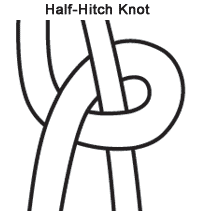
              The method of construction is termed hitching, which takes half-hitch knots, using sets of plied horsehair, called “pulls”.  Since mane hair is generally too short and too soft, tail hair is used.  Pulls can also be braided, but braiding does not produce a silky, durable product, although braiding is definitely easier and quicker.
        

              South Americans have long used crin to create textiles, including beautiful mosaic designed carpets, using weaving techniques (usually flat woven techniques such as Soumak).   Crin offers good wear due to its strength, has nice tactile texture and accepts dyes     


              In a recent showcase of Chilean handcrafts were many examples of fine crin-work made into fanciful accessories.


Hair can be purchased cleaned, in bundles from firms overseas, usually in black or white.  Imported horsehair is, most often, used in making bows for violins and various stringed instruments. Musical instrument dealers who rehair bows are another source but natural horsehair should be ordered, not synthetic.  Also check the internet for US suppliers who sell hanks of  hair in various lengths and colors, usually by the pound ( a pound would make a lot of keychains!!)