Friday, March 29, 2013

Spring Animals- Embroideries from the 1930's


Spring Animals – Embroideries from the 1930’s

Well, it is spring here, at least in Santa Fe.  Hopefully, soon the nice weather will reach you also, although I can remember, living in New England, snow packs until May.
 So to celebrate the season I have selected several children-themed embroideries from the 1930’s.


This is a feedsack, technically, the more correct name would be “textile bag”, which as you can see by the remaining lettering, contained dried beans.  Textile bags were used as packaging for every imaginable dry item, from flour and sugar to voting ballots and ammunition.  Ultimately, following WWII the paper bag manufacturers managed to supplant the cloth bag industry by deeming their bags “unsanitary”, although other countries continued to use this packaging.  During the peak of textile bag use various producers of goods vied for customers and used their packaging to encourage sales.  During the depression it was a bonus if your flour sack could also be used as fabric for curtains or a child’s dress or patches for a quilt.  Often small bags were imprinted with designs for embroidery.  As you can see, one of the disadvantages of using such cloth for décor was the label printing that often remained despite repeated washings.


These two matted embroideries were, perhaps, patches from an embroidered child's spread or pillow cover.


 This is an embroidered  sham for a child's pillow.


Small pieces of  vintage embroidery can be readily found in thrift stores and on-line.  They add great charm to any child's room. 

Friday, March 22, 2013

Jacquard Loom


Key Punch, Anyone?  Joseph Marie Jacquard and his Automated Loom

Weaving complicated designs in the 18th C was a very time consuming endeavor.  Anything beyond the most simple of patterns required an additional weaver to manipulate the shed (the potential space between the warp threads). There had been many attempts to automate this process. 


Joseph Marie Charles dit Jacquard

Joseph Marie Charles dit Jacquard (b.1752, d. 1834) was the son of a silk weaver and had many varied careers  until the early 1800’s when he began experimenting with new designs for looms that could weave patterned silk. He proposed a series of perforated paper pieces which carried the design formula and were stored on a drum on the loom.  The heddles (attached to hooks and the punched paper) were controlled by this process and one weaver could operate the loom and produce complex cloth more rapidly. One row of punch cards represented one row of woven design.  Initial problems with this punch card system were solved by Jean Antoine Breton and the Jacquard loom was further perfected as Jacquard worked with Jacque Vaucanson. 


Jacquard loom  Note the perforated  cards hanging to the right  rear of the loom.


The silk weavers were opposed to this automation, however Napoleon declared Jacquard a “hero” and awarded him a pension and royalty on all looms sold.  By his death, the Jacquard loom was in wide use and the idea of using punch cards was carried forward into the 20th C for the computer and other office machine industries.

The first modern advance in the innovation of this loom used optical scanners to import the design to computers and automatically produced the necessary punch cards.  Now, designs are electronically computerized and patterns are stored on disks.  Lifting devices are directly hooked to the heddles and , therefore, the loom can  easily switch from one complex design to another.

Friday, March 15, 2013

Irish Lace


They say on the 17th of March everyone is Irish, according to my grandmother.  Ireland is known for many things, including shamrocks, sheep and green, green grass. For textile enthusiasts there is also Irish linen and lace.


   Irish linen souvenir towels


There are several types of lace that were made in Ireland in the late 18th C (in small amounts from croft workers) and in the mid 19th C when nuns and professional teachers designed and taught lace techniques, founded schools and centers.  Their students became the teachers and were sent to villages throughout the district.  The main centers were Monaghan and Cloves in the north and Cork in the south.


 Four types of Irish lace are generally recognized:
 Limerick – tamboured embroidery made on a machine-made bobbin net.


Carickmacross – appliqué muslin, again on a machine-made net, was surrounded by a cordonnet (raised edge covered entirely by stitching).


 Younghal – flat needle- lace that was made to resemble Venetian needle-lace with many motifs surrounded by buttoned-holed loops and scallops.  Sometimes made in cotton but usually in linen thread.


Irish Crochet Lace – This may be the most familiar of the Irish laces.  Shamrocks, bunches of grapes, daisies and roses were the most common motifs.  Raised effects were  created by using several thicknesses of threads - for instance, thread was wound around a rod or pencil to form a ring.  The ring was then worked over with a double or triple crochet or buttonhole stitch.  The overall design was traced on a linen ground and when the motifs were finished they were tacked onto the pattern and filling crochet stitches were worked around the motifs.  This techniques was adapted to imitate continental needle-made laces such as Venetian Rose Point.


Erin Go Brach!!!

Friday, March 8, 2013

Hmong Pa ndau Embroidery


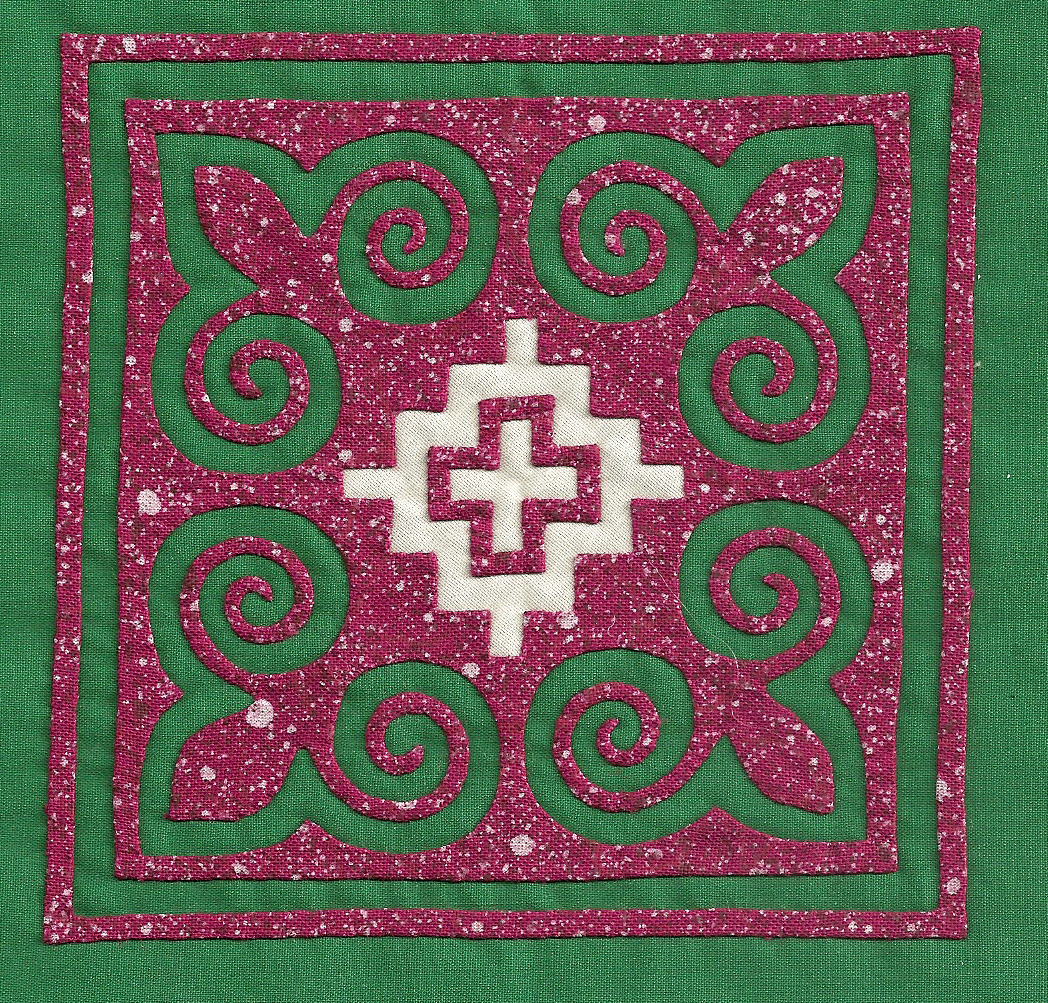
The Hmong are an ethnic people, originally from the mountainous regions of China who were relocated southward by the Chinese government (along with other tribes) in the 18th C to become one of the subgroups of Miao ethnicity. In the mid 19th C they migrated to the mountainous regions of Laos, Thailand and Viet Nam.  During the Viet Nam War many of those living in Laos and Viet Nam aided the American effort and when the US left the area they were forced to flee to refugee camps in Thailand.  Eventually, many emigrated to the US.

The Hmong have brought with them their beautiful needlework called Pa ndau (pronounced pond-ouw) meaning “flower cloth”.  Pa ndau includes crewelwork,  cross-stitch, embroidery, needlepoint and reverse appliqué.  The most noteworthy is reverse appliqué.


                                                   Wallace-Homestead Book Co., 1984


A few months ago, I wrote a blog about the San Blas Kuna Indians of Panama and their tradition of mola-making (also using reverse appliqué).  You cannot mistake one tradition for the other.  Mola makers use mainly pictorial motifs while Hmong stitchers use geometric designs.  To obtain the amazing symmetry of their geometrics, the Hmong precut the multifolded design before assembling the layers, while Molas are layered first and then the design is cut. Molas are rarely symmetrical due to their pictorial nature.


 Molas 


                                                              Pa ndau


The stitches in Pa ndau appliqué are nearly invisible.  After the reverse appliqué is complete, embellishment may be added by extremely fine embroidery or the addition of further reverse appliqué or simple surface appliqué. 


                              Three Ring Snailhouse Motif                            


                                                       Heart Motif


         Heart
           Motif


                    Elephant's Foot Motif


Leaf'Petal Motif

Bar Morif with Rickrack corners


Rams Head  Motif
Rams Head Motif with Simple Cross


Rams Head Motif with Simple Cross


Hearts and Rings Motif


Petitpoint needlepoint Pa ndau


Friday, March 1, 2013

European Machine-made Tapestries


European Machine-made Tapestries

Years ago I worked for an on-line appraisal company where clients sent in pictures and descriptives of items for which they wished professional identification and comments.  My area was 19th C and 20th C European and American textiles. More than ½ of all textiles I viewed were late 19th C, early 20th C European machine-made tapestries.

Tapestries have a long textile history.  Many world areas created woven pictorial textiles to adorn their interiors.  With the invention of the Jacquard loom, intricate patterns could be woven much more quickly than patterned textiles woven entirely by hand.  However, there is something very special about the hand-woven tapestries created in workshops by highly trained weavers.  These were very large pieces, made to hang on the walls of palaces and manor houses of the wealthy.  They could be taken with the household goods and furniture when the family moved from one residence to another.  Too often they were altered (by cutting to fit a smaller space) but remaining tapestries offer a view into a world that appreciated a different aesthetic.  These textiles were allegorical, depicting mythology as well as religious themes, many showed bucolic, pastoral scenes of peasant life.

It comes as no surprise, then, that during the last decades of the 19th C the newly emerging middle class wished to emulate the highly esteemed home furnishings of the past. Many industries, especially the textile industries, were being modernized with efficient machinery that was supposed to closely mimic hand- crafted products.  Sometimes they succeeded, sometimes not so much.  But they definitely were able to produce modestly priced goods.  The demand for tapestry-like textiles to drape over furniture pieces, and occasionally hang on the walls resulted in the production of thousands and thousands of small weavings.  They also were allegorical.  The themes were rural and mythological but in keeping with the great interest in foreign travel (especially in the Middle East and North Africa) many featured scenes of exotic lands as well as century-old European life.


How can one identify these textiles?  Hand-woven tapestries, whether antique or modern, have a discontinuous weft, while machine-made textiles have a weft that continues along the reverse of the fabric.  At times, some of this continuous weft is trimmed to reduce bulk but this leaves a fuzzy appearance on the reverse.  Secondly, the size is much smaller than antique, usually rectangular, to fit over the top surface of furniture (table tops and pianos).  Thirdly, the color of these newer textiles is much softer, with a grayed background (suggesting age?) and a more pastel palette.

There are still many of these textiles to be found in thrift and antique shops.  While many may have faded and damaged areas they are perfect for pillows.  Imagine a bookcase lined with some of these samples or used as matting for vintage photographs.

Friday, February 22, 2013

Depression Quilts


Depression Quilts

Some have called quilts made in the 1930’s “depression quilts”.  For the most part these were actually bright, cheery pieced quilts constructed from small cotton scraps.  One word here, the quilters did not cut up clothing to make their quilts!!!!! Clothing was patched, darned, hemmed and lengthened and handed down when outgrown.  Clothing that was too worn or stained could have been used to make rag rugs, but usually not quilts.  What was used were scraps of cotton fabric left after cutting clothing patterns or curtains.  The dress fabric from your sister’s favorite dress that you see in your patchwork quilt was pieces of these leftovers.  Often, women would save bags of scraps and then share them so that there was a wide variety of fabrics for piecing.  Some of the 1930’s quilts were made from hundreds of very small pieces of cloth.  There were contests with prizes for the quilts with the most pieces, or the smallest pieces (some were the size of postage stamps). 

Today I wish to share quilts, or rather bedcovers (these had no middle batting, only a pieced front and backing, usually tied, not quilted) that are not bright, cheery, nor made from small scraps but come from the decades of the Great Depression.  While these were not particularly artful, nontheless, they were perfectly suited for a man’s or boy’s bed and were very warm.


These quilts are made from men’s wool suiting fabrics.  Of course, they were not made from men’s suits.  Most men had only one suit, if they were lucky, and I cannot imagine any housewife taking a pair of scissors to the garment.  Again, they did not cut up clothing to make quilts during this period. Looking carefully at the wool pieces it is apparent that these fabrics were samples from woolen mills.  Salesmen would take sample books of swatches to tailors and off-the-rack clothing manufacturers who, in turn, could order yardage.  When the mill issued a new line of fabrics in the latest colors and patterns, the old fabrics were retired and new sample books were distributed.  The old samples were perfect for patchwork as they were already cut to a standard size and ready to sew.  How fortunate to have a source for these sample books!!


Friday, February 15, 2013

Hooked Rugs and Cushions


Hooked Rugs and Cushions


Floor coverings in the 1800’s ranged from very expensive woven wool carpets to cheaper in-grain woven carpets to straw and rush mattings.  The straw mattings were popular until nearly the 20th C as they were used to protect more expensive carpeting from wear.  They could easily be removed, cleaned and replaced near doorways and fireplaces which received the most dirt.  Unfortunately, the straw mattings were not very durable. By the mid-19thC housewives were choosing floor cloths (oil cloths that they could paint in patterns) which were easy to clean and therefore useful in the kitchen, but lacked warmth. Other, small fabric rugs, were frequently sewn by the homemaker.  The most popular of these were hooked rugs with designs ranging from simple geometrics to the elaborate and complex. Due to the simplicity of the technique these rugs and mats remained popular throughout the 19th C and experienced a revival during the early 20th C.when rug-hooking classes were offered and women used these occasions for social gatherings( much like quilting bees).


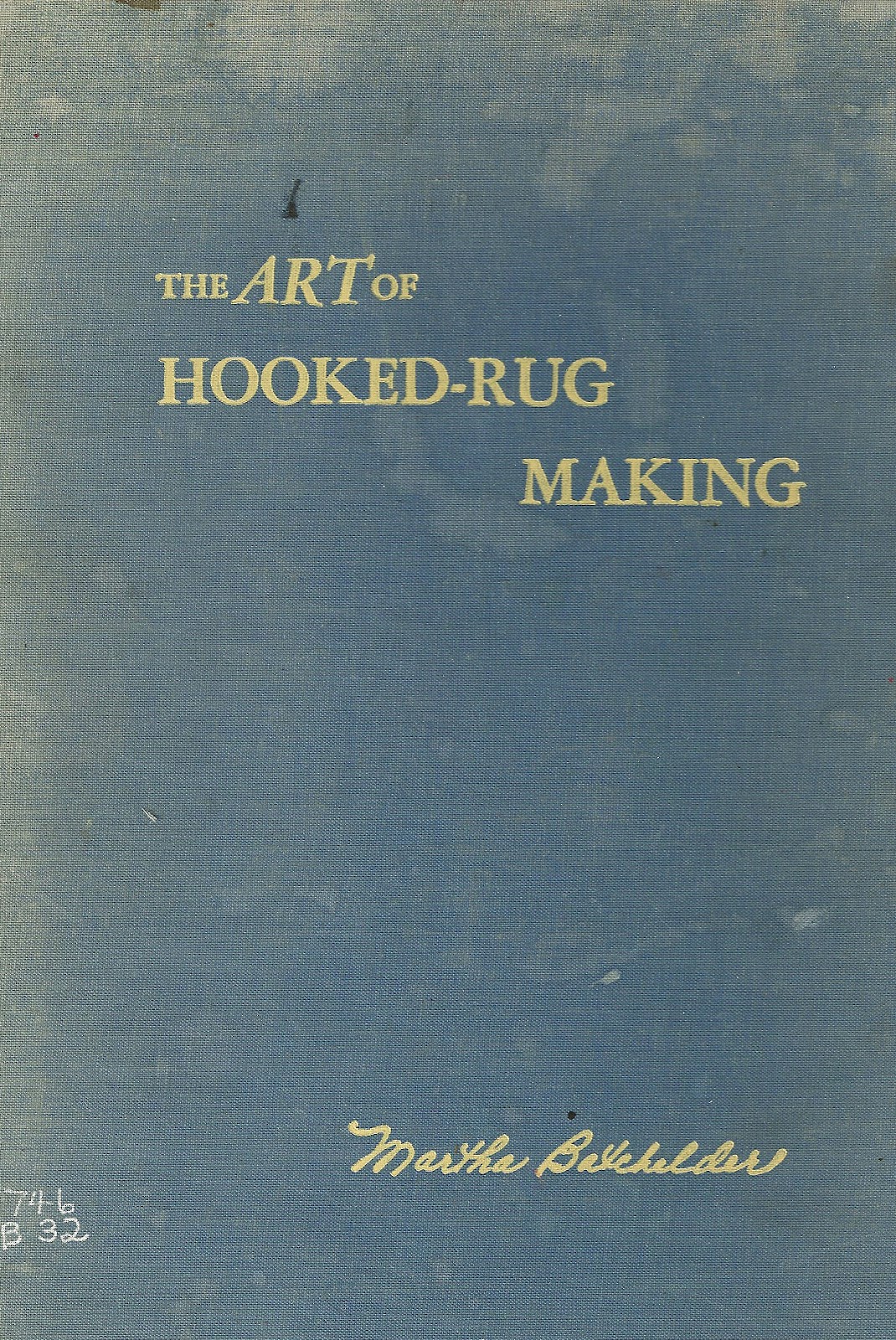
You can still find old books on rug hooking instruction.


Strips of wool can be cut to the wanted width with mechanical strippers.


Purchased wool is available in strips of varying widths and a rainbow of colors


The wool strips used  (probably firstly from scrap wool) were drawn from the back to the front of the ground fabric with a hook to form loops.  Properly done, the loops were of even height and the beginning and ending “tabs” of the strips were brought to the front of the rug (later they would be trimmed flush with the pile of the finished mat) thus insuring the row of loops would not be pulled out. Most were hooked on loosely woven jute or burlap.


 Hand held rug hooks


To fill in large background areas, some used “speed hooks”.  Speed hooks do what hand held hooks do, but in a different way.  While hand hooks lift the yarn from the underside of the foundation cloth, forming loops on the top side, speed hooks pushes the yarn from the top side into loops on the under side.  Therefore the finished surface is the under side.
Susan Burr Needle (speed needle) could be used with strips of varying widths and could be adjusted to make loops of varying heights.


So-called “latch hooked rugs” are made with a tool that makes knotted rugs using cut pieces of yarn.  The rugs have a shag surface instead of the even surface of a hooked rug.


19th C rug.  Note most vintage rugs show worn areas and fading.


You can tell by looking at the reverse the original colors.


20th C hooked rug


Kits for hooked rugs, mats and cushions are available.

Finished cushion 

Cushion in progress

To-do cushion


One source of kits, yarns and hooking equipment ( as well as rug-braiding supplies) is The Dorr Mill Store, Newport New Hampshire